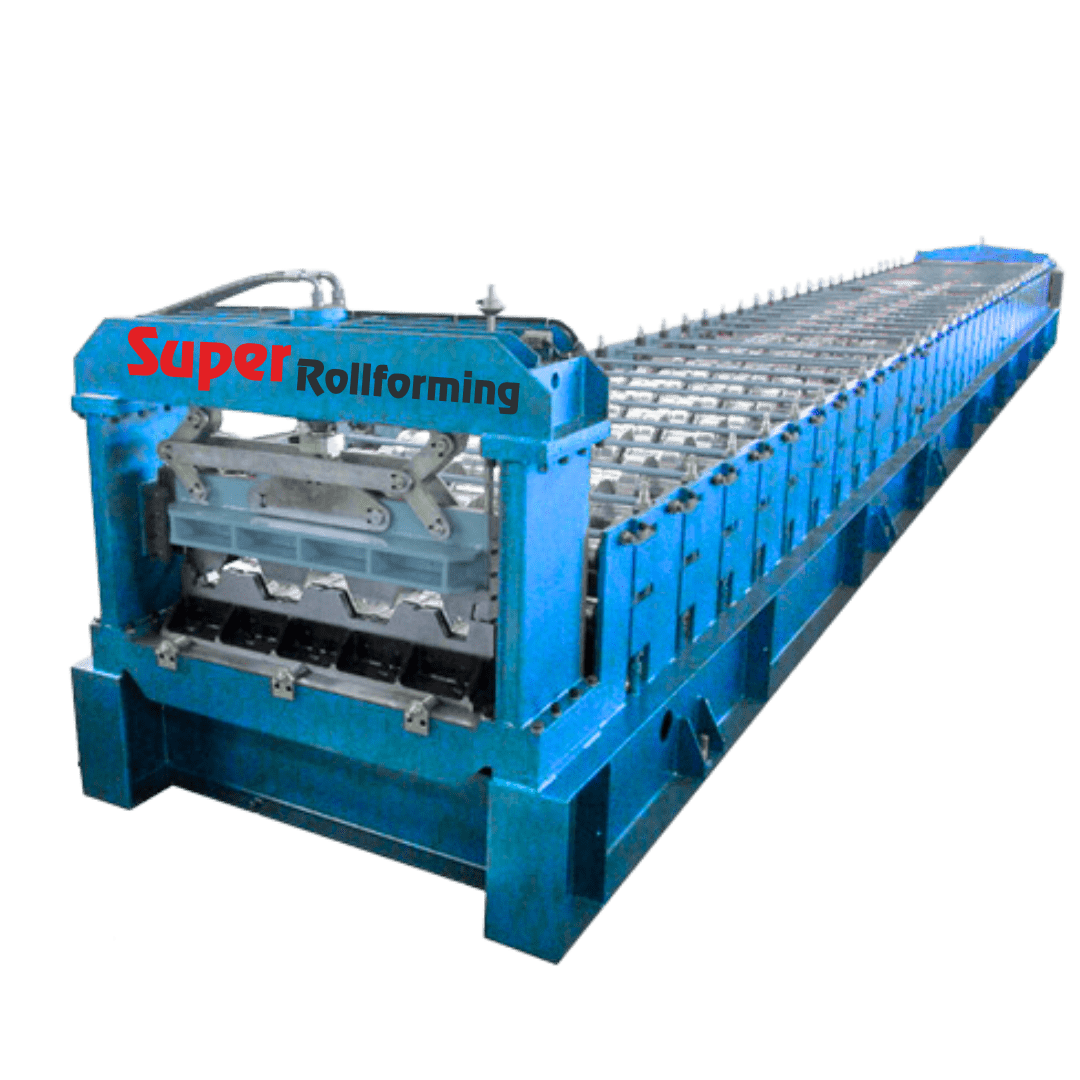
What Separates Roll Forming From Other Steel Shaping Methods
Many fabricators consider multiple metalworking methods before committing to a steel deck roll forming line. Understanding the core differences clarifies why roll forming dominates high-volume structural deck production globally.
Press braking forms individual panels through a series of precise, single bends applied sequentially. It suits low-volume, high-variety work but cannot match roll forming's output rate for repetitive profiles. Stamping presses produce panels quickly but require expensive dedicated tooling for every profile change and struggle with longer panel lengths.
Roll forming, by contrast, processes steel continuously. The coil feeds through forming stations at speeds between 20 and 45 meters per minute, producing finished panels non-stop. According to the Steel Deck Institute, roll-formed composite deck systems now account for the vast majority of structural floor and roof deck installations across North American commercial construction — a clear validation of the method's industrial dominance.
Super Rollforming engineers its equipment around this continuous production model — maximizing speed, minimizing interruptions, and maintaining dimensional consistency throughout every production run.
How a Deck Forming Machine Converts Raw Coil Into Structural Panels
Understanding the production sequence helps fabricators evaluate equipment more effectively. A modern deck forming machine from Super Rollforming operates through five integrated stages:
Coil Loading and Decoiling A motorized decoiler unwinds the steel coil at a controlled rate. Proper tension management at this stage prevents material distortion before forming begins. The decoiler capacity matches the line speed to ensure uninterrupted feeding.
Material Leveling The steel strip passes through a multi-roller leveling unit. This stage removes coil curvature and internal stresses from the material. Flat, stress-free entry into the forming section is essential for accurate profile geometry.
Progressive Roll Forming The flattened strip moves through a sequence of forming roll stations. Each station applies incremental bending force, gradually shaping the steel toward the final structural deck profile. The number of stations varies with profile complexity — typically ranging from 14 to 24 passes for standard deck configurations.
Automated Panel Cutting A servo-driven flying shear or hydraulic cutting system severs the formed panel at the programmed length. Flying shear systems cut the panel while the line continues moving — eliminating the production pause that fixed shear systems create. This maintains continuous output at full line speed.
Panel Runout and Stacking Finished panels travel along a runout table and stack into bundles for handling or direct loading. Automated stacking systems further reduce labor requirements on high-volume lines.
Engineering Features That Make Super Rollforming Equipment Stand Out
Super Rollforming builds forming systems with a clear engineering philosophy — every component must contribute directly to production performance and equipment longevity.
Precision CNC-Ground Forming Rolls
The forming rolls define panel quality. Super Rollforming manufactures its rolls from high-alloy tool steel, CNC-ground to exact profile tolerances and heat-treated for surface hardness. Hardened roll surfaces resist abrasive wear from galvanized and high-strength steel coils — maintaining dimensional accuracy across millions of linear meters of production.
Fully Welded Stress-Relieved Frame
The machine base consists of heavy structural steel sections, fully welded and thermally stress-relieved. Frame rigidity prevents deflection under forming loads — and deflection is the hidden cause of panel camber and cross-bow in lower-grade equipment. Super Rollforming's frame engineering eliminates this failure mode by design.
Multi-Profile PLC Control System
The integrated PLC automation platform stores multiple deck profile programs simultaneously. Operators select profiles from a digital menu rather than manually repositioning mechanical stops. This capability reduces profile changeover time significantly — a critical advantage for fabricators running mixed-profile production schedules.
Configurable Profile Range
Super Rollforming configures machines for the full spectrum of structural steel deck profiles:
- 1.5-inch B-Deck — standard commercial roof and floor deck specification
- 3-inch W-Deck — long-span structural floor applications
- Dovetail Deck — engineered composite slab systems with mechanical interlock
- Deep Rib Deck (4.5-inch and above) — heavy industrial floor and mezzanine loading
- Custom engineer-specified profiles — produced from customer structural drawings
Application Spotlight: Multi-Story Commercial Floor Deck Production
A structural steel fabricator in the southeastern United States supplies composite floor deck panels to commercial developers across Georgia, Florida, and Tennessee. Their standard specification covers 3-inch W-Deck and 1.5-inch B-Deck in gauges from 22 to 16, with cut lengths from 8 to 32 feet.
Before upgrading, their older forming line required manual length measurement and a two-person shear operation. Profile changes took nearly three hours. After commissioning a deck forming machine from Super Rollforming, their line speed increased to 34 meters per minute with fully automatic cutting. Profile changeover dropped to under 25 minutes using stored PLC programs. Their monthly output volume increased by approximately 42% without adding headcount.
The improvement in panel dimensional consistency also reduced site callbacks — contractors reported faster installation times due to better profile uniformity across bundles.
Verified Customer Experiences
"Super Rollforming delivered exactly what they specified. The machine has been running two shifts daily for over a year without a single major mechanical issue. Panel quality is consistent, the PLC system is intuitive, and their after-sales support team responds quickly when we have questions. This is genuinely well-built equipment." — Production Manager, Structural Deck Fabricator, Houston, Texas
"We were skeptical about switching suppliers after a poor experience with previous equipment. Super Rollforming's engineering team walked us through every specification detail before we committed. The machine arrived on schedule, commissioned within three days, and has performed reliably ever since. We've since ordered a second line." — Director of Operations, Steel Fabrication Group, Melbourne, Australia
Frequently Asked Questions
Q1: What forming speed does a professional deck forming machine typically achieve? Modern roll forming lines operate between 20 and 45 meters per minute depending on profile complexity, material gauge, and cut length. Super Rollforming optimizes line speed for each specific configuration to balance output rate with panel quality.
Q2: How many roll stations does a standard deck forming machine require? Standard deck profiles typically require between 14 and 24 forming stations. More complex profiles with tighter radii or multiple rib geometries may require additional stations. Super Rollforming engineers the station count based on profile geometry and material specifications.
Q3: Can Super Rollforming machines process high-strength steel coils? Yes. Super Rollforming configures forming roll geometry, station spacing, and drive power specifically for high-strength and ultra-high-strength steel grades where required by customer specification.
Q4: What installation and commissioning support does Super Rollforming provide? Super Rollforming provides on-site installation supervision, complete machine commissioning, operator training, and initial production verification as standard elements of every equipment delivery.
Q5: How long is the typical lead time for a custom-configured forming line? Lead times vary based on configuration complexity and current production scheduling. Contact Super Rollforming directly for a current lead time estimate based on your specific requirements.
Conclusion
Structural steel deck fabrication operates on precision, speed, and reliability. Fabricators who lead their markets understand that production performance traces directly back to equipment quality. Investing in a purpose-built deck forming machine from Super Rollforming means investing in consistent panel dimensional accuracy, advanced PLC-driven automation, robust CNC-machined roll tooling, and a machine frame engineered to perform across years of high-volume production. Whether your facility produces B-Deck, W-Deck, dovetail profiles, or custom structural configurations, Super Rollforming has the engineering depth, manufacturing capability, and application experience to build the right solution precisely matched to your production requirements. Make the move that transforms your production capacity. Visit Super Rollforming today, review full machine specifications, and connect with their technical team for a detailed consultation and custom equipment proposal.